
What Is a Fringe Benefit – Saving Money, Boosting Retention
- Sydney Little
- Feb 16
- 6 min read


Keeping good people has become harder, not easier. For many nonprofits or care-focused employers, wage increases aren’t a go-to solution. Budgets are tight, turnover is disruptive, and employees are looking for more than a paycheck.
This is where fringe benefits come in.
Fringe benefits are often treated as secondary to base compensation, but in practice, they shape how employees experience their work, their financial security, and their relationship with the organization. When designed intentionally, fringe benefits can control costs, improve retention, and strengthen culture without creating long-term financial strain.
This article explains what fringe benefits are, how they work in employment, and how leaders can use them as a practical tool—not an expense line to manage defensively.
Table of Contents
What Is a Fringe Benefit?
A fringe benefit is any form of compensation provided to an employee in addition to their regular wages. In simple terms, it is the part of compensation that does not show up as hourly pay or salary but still carries real financial value.
The formal fringe benefits definition comes from the IRS, which classifies fringe benefits as taxable unless specifically excluded. In practice, however, fringe benefits are better understood as tools employers use to support employees’ health, financial security, and overall stability.
Examples include health insurance, retirement contributions, paid time off, life insurance, transportation assistance, and professional development. These benefits are not incidental. They influence whether employees feel supported and whether they can afford to stay.
Many leaders still view fringe benefits as optional or discretionary. That mindset is outdated. In today’s labor market, fringe benefits are part of core compensation. Employees compare them just as closely as wages—sometimes more closely.Employer Misconception Alert: Many organizations mistakenly view fringe benefits as unnecessary expenses rather than strategic investments in human capital. In reality, well-designed benefit packages can significantly reduce turnover, improve employee morale, and create a more engaged workforce.
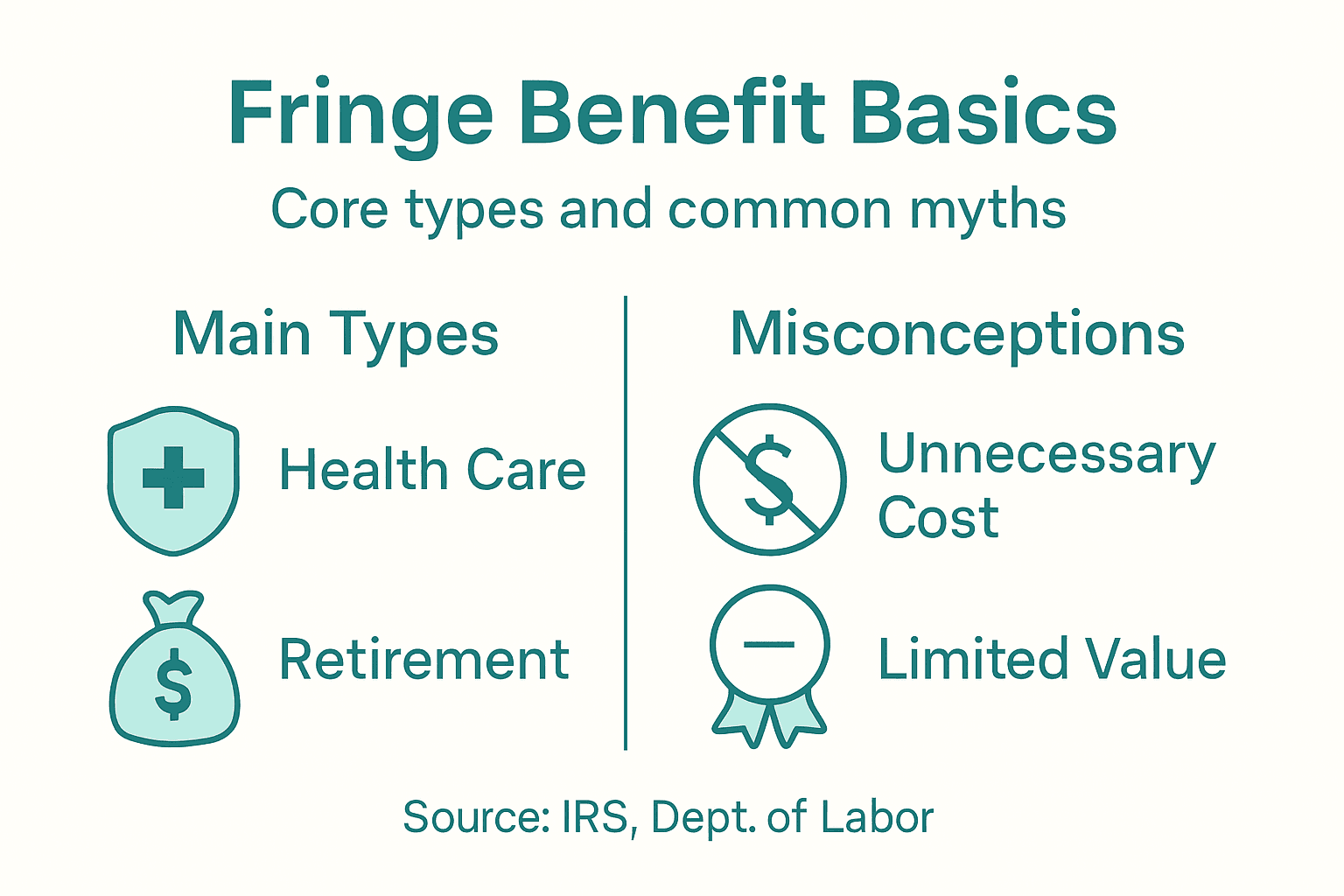
Pro tip: Regularly audit your fringe benefit offerings to ensure they remain competitive and aligned with your workforce’s evolving needs and expectations.
Major Types of Fringe Benefits for Employees
There is no single list of required fringe benefits beyond legally mandated items. Instead, organizations choose from a range of benefit types based on workforce needs, budget constraints, and long-term strategy.
Some of the most common types of fringe benefits include:
Health and Welfare Benefits Medical, dental, and vision coverage remain the most visible fringe benefits. These benefits address immediate financial risk and are often the deciding factor in employment decisions.
Retirement and Savings Benefits 401(k) plans, employer matches, and pension contributions support long-term financial security. They also encourage retention by rewarding tenure.
Paid Time Off Vacation, sick leave, and personal time support recovery and work-life balance. These benefits reduce burnout and improve productivity over time.
Insurance Protection Benefits Life insurance and disability coverage protect employees against income loss. These benefits are often undervalued until they are needed, which is precisely why they matter.
Work-Life and Flexibility Benefits Flexible schedules, remote work options, and family support benefits address practical constraints employees face outside of work.
Professional Development Benefits Training, certifications, and tuition reimbursement signal long-term investment in employees’ growth.

Why Fringe Benefits Matter for Retention and Stability
Retention is not driven by compensation alone. Employees stay when their lives feel manageable and predictable. Fringe benefits play a central role in that equation.
When benefits are well-designed, employees experience fewer financial shocks. Medical bills are less destabilizing. Time away from work feels possible. Long-term planning becomes realistic. This stability builds loyalty in ways wages alone cannot.
The benefits of fringe benefits extend beyond individual employees. Organizations with strong benefit structures see lower turnover, fewer unplanned absences, and more consistent performance. Over time, this reduces recruiting costs and operational disruption.
There is also a signaling effect. Benefits communicate priorities. When employees see that an organization invests in health coverage, financial protection, and flexibility, they interpret that as respect. That perception shapes culture more than any mission statement.
By strategically designing benefit packages that address diverse employee needs, organizations can significantly reduce turnover rates. These investments demonstrate a profound understanding that employees seek workplaces offering more than just a paycheck - they want environments that support their personal and professional growth.
Here’s a summary of how common fringe benefits contribute to employee retention strategies:
Benefit Type | Retention Impact | Business Advantage |
Health Insurance | Reduces stress, increases loyalty | Lowers absenteeism and turnover |
Professional Development | Fosters growth, builds engagement | Cultivates future leaders |
Paid Leave | Supports work-life balance | Improves workplace satisfaction |
Retirement Plans | Enhances financial security | Attracts long-term talent |
Wellness Programs | Promotes overall well-being | Boosts productivity and morale |
Pro tip: Regularly benchmark your benefits package against industry standards and conduct anonymous employee surveys to ensure your offerings remain competitive and meaningful.
Tax Treatment and Compliance Considerations
Fringe benefits exist within a regulatory framework, and understanding that framework is essential. The IRS generally treats fringe benefits as taxable unless specifically excluded.
Some benefits, such as employer-sponsored health insurance, are typically excluded from taxable income. Others, like cash bonuses or certain allowances, are taxable. Some fall in between, with partial exclusions or limits.
Compliance requires accurate classification, valuation, and reporting. Errors often occur when benefits are misclassified or when documentation is incomplete. Over time, small mistakes can create significant exposure.
This is why fringe benefits should be reviewed regularly with both HR and financial oversight. Compliance is not just about avoiding penalties. It is about maintaining trust with employees and regulators alike. See the table below for a comparison of tax implications
Benefit Category | Typical Tax Treatment | Key Documentation Needed |
Health Insurance | Usually non-taxable | Proof of coverage |
Transportation Assistance | Partially taxable | Usage records, receipts |
Moving Expense Reimbursement | Partially taxable | Valid expense receipts, approval |
Cash Bonuses | Taxable | Payroll records, W-2 inclusion |
Working Condition Benefits | Non-taxable | Evidence of business relevance |
Maximize Your Benefits to Save Money and Boost Employee Retention
Understanding and managing benefits takes more than checking boxes. It requires balancing cost, compliance, and employee experience in a way that supports both your people and your organization’s long-term stability.
At Thrive Benefits Group, we work with employers to evaluate existing benefit structures, identify inefficiencies, and design benefit strategies that are sustainable, compliant, and aligned with real workforce needs. Our approach focuses on clarity, cost control, and practical decision-making—not unnecessary complexity.
If you want a clearer picture of how your benefits are working today, and where adjustments could improve retention or reduce risk, we’re happy to start with a\ conversation.
Key Takeaways
Fringe benefits are not secondary compensation. They are a central component of how employees evaluate their work and their future.
Understanding what fringe benefits are, how they work in employment, and which types matter most allows organizations to design packages that support retention and financial stability.
When managed strategically, fringe benefits control costs, reduce turnover, and strengthen organizational resilience.
Frequently Asked Questions
What is a fringe benefit in simple terms? A fringe benefit is any form of compensation an employee receives beyond their regular wages. This includes benefits like health insurance, retirement contributions, paid time off, and insurance coverage. While they do not appear as salary, they carry real financial value for employees.
What are employee benefits versus fringe benefits? Employee benefits is a broad term that includes all non-wage compensation. Fringe benefits are a subset of employee benefits and are typically defined by tax and regulatory rules. In practice, the terms are often used interchangeably, but fringe benefits usually refer to benefits with specific tax treatment considerations.
What are common examples of fringe benefits? Common examples include health and dental insurance, retirement plan contributions, life and disability insurance, paid leave, wellness programs, flexible work arrangements, transportation assistance, and professional development support.
Are fringe benefits required by law? Some benefits are legally required, such as Social Security, unemployment insurance, and workers’ compensation. Most fringe benefits, however, are discretionary and offered at the employer’s choice as part of a broader compensation strategy.
How do fringe benefits affect employee retention? Fringe benefits reduce financial stress and improve stability for employees. When workers feel supported through healthcare, insurance protection, and time-off policies, they are more likely to remain with an organization long term.
Are fringe benefits taxable? Some fringe benefits are taxable, some are not, and others are partially taxable. For example, employer-sponsored health insurance is typically non-taxable, while cash bonuses are taxable. Certain benefits have limits or conditions that affect tax treatment.
What is the most common fringe benefit offered by employers? Health insurance remains the most common and most valued fringe benefit. It addresses immediate financial risk and is often a deciding factor in employment decisions.
How do employers control the cost of fringe benefits? Employers manage costs by pooling risk, selecting benefits that align with workforce needs, reviewing plans annually, and ensuring benefits are structured efficiently from a tax and compliance standpoint.
Recommended



Comments